
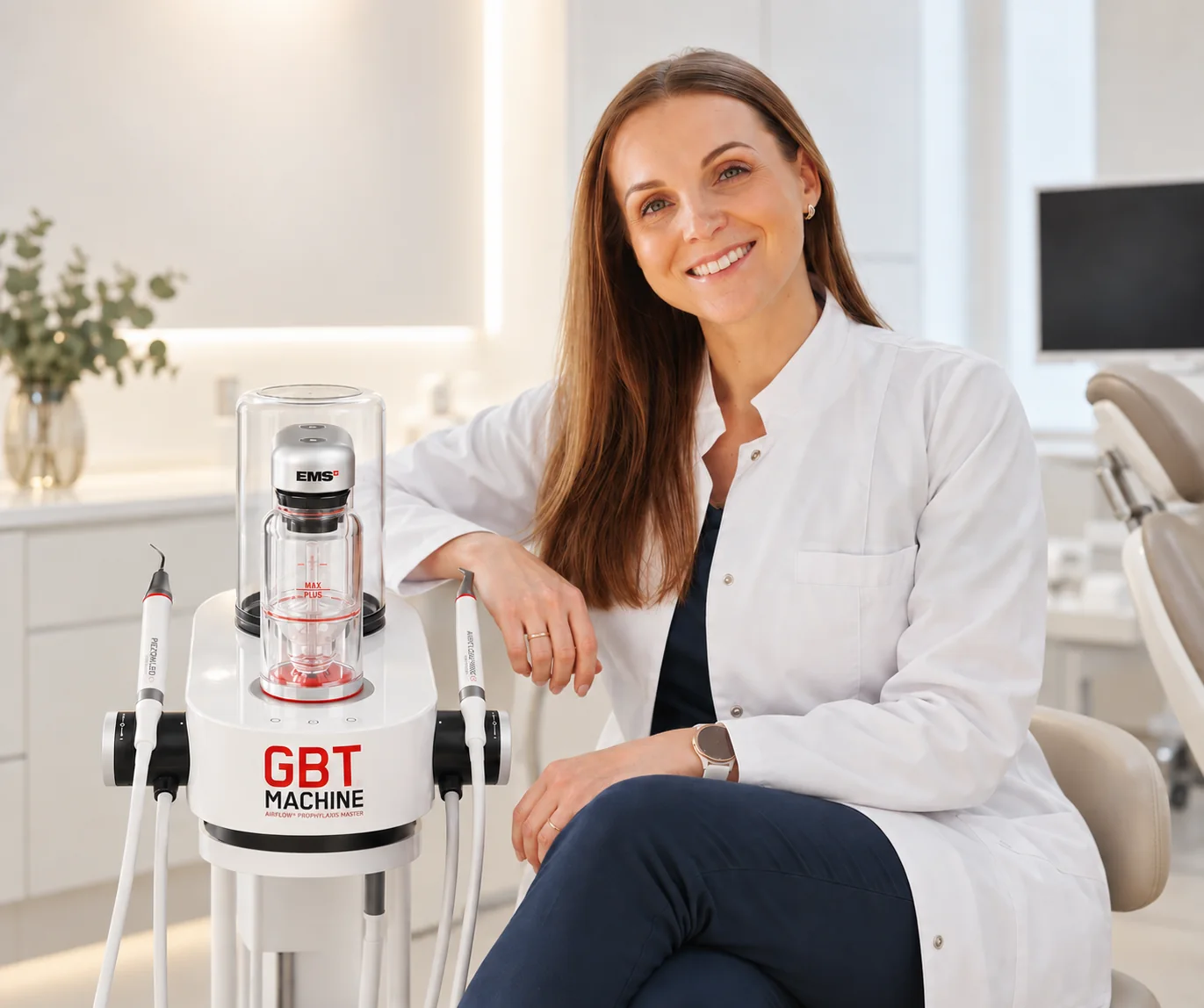
An explanation from Dr Agnese Breidaka, a specialist in cosmetic dentistry and implantology
If your teeth tend to be sensitive after a dental hygiene appointment, or if the procedure itself feels uncomfortable, it is worth finding out about Guided Biofilm Therapy, or GBT. This is the latest generation of professional dental hygiene, in which bacterial plaque, or biofilm, is first stained and located, then specifically removed using a jet of air, warm water and fine powder. Any remaining hard tartar is removed separately using a suitable ultrasonic instrument.
The main benefit for the patient is a precise and gentle procedure: the dental hygienist can see exactly where the plaque is located and uses the instruments only where necessary. Here are five reasons why Smile Art patients choose gentle GBT dental hygiene.
1. The problem is first made visible
Dental plaque is not always visible to the naked eye. At the start of the GBT procedure, a special indicator is applied to the teeth, which colours the plaque. This helps the dental hygienist to pinpoint exactly where cleaning is needed, and allows the patient to see for themselves the areas where their daily oral care needs improvement.
This step makes the procedure more precise. Cleaning is not carried out ‘by feel’ — it follows the visible plaque. At the same time, the patient receives specific recommendations on tooth cleaning products, interdental brushes or dental floss for the very areas where plaque accumulates most.
2. Many patients find the cleaning process gentler and more comfortable
AIRFLOW technology — a controlled jet of air, water and fine powder — is used to remove GBT biofilm and surface stains. Compared with prolonged mechanical polishing or the use of instruments, many patients appreciate the gentler sensation and reduced discomfort. Research reviews indicate that patients who have undergone GBT hygiene report greater comfort following the procedure.
This can be particularly important for people with sensitive teeth, a fear of the dentist or unpleasant past experiences.
3. A conservative approach to restoration
The aim of the modern GBT protocol is to remove biofilm whilst minimising the impact on healthy tissue and restorations. A correctly selected powder and tip allow for the cleaning of teeth as well as areas around crowns, veneers, braces and implants.
This is particularly important for patients with extensive restorations or implants, as they do not need to worry that the dental hygiene procedure might damage any veneers or porcelain crowns in their mouth.
4. External pigmentation is effectively removed
Coffee, tea, red wine and smoking can cause external staining on the surface of the teeth. The AIRFLOW jet is highly effective at removing biofilm and many superficial stains, so your teeth look cleaner and brighter after the treatment.
It is important to distinguish between dental hygiene and teeth whitening. GBT is not a chemical whitening treatment. It removes surface stains, revealing the teeth’s natural colour. If the desired result is an even brighter smile, professional teeth whitening should be scheduled after the hygiene treatment.
5. The procedure is tailored to the individual patient
GBT dental hygiene is tailored to each patient’s individual needs — from selecting the most suitable powder and jet intensity to the particularly thorough cleaning of problem areas. After the procedure, the hygienist draws up a personalised oral care plan and a schedule for future hygiene appointments, taking into account gum health, tartar build-up, implants, restorations and daily oral care habits.
Frequently asked questions about GBT dental hygiene
Does GBT dental hygiene hurt?
Many patients describe it as more comfortable than traditional scaling, although the experience varies from person to person. Sensitivity can be affected by exposed tooth necks, gum inflammation and the amount of tartar. The dental hygienist adapts the procedure to the patient’s sensitivity.
Are GBT and Airflow one and the same?
AIRFLOW is a technology for removing biofilm and pigmentation. GBT is a more comprehensive, step-by-step treatment protocol in which AIRFLOW is one of the stages, alongside diagnosis, biofilm staining, tartar assessment and a personalised prevention plan.
Does GBT remove tartar?
AIRFLOW primarily removes soft biofilm and surface staining. Hard tartar is removed using ultrasonic or hand-held instruments where necessary. Therefore, during a professional GBT appointment, the methods are combined according to the specific condition.
Do teeth become whiter after GBT treatment?
Once external staining has been removed, teeth may appear brighter and cleaner; however, GBT is not a teeth-whitening treatment and does not alter the tooth’s natural intrinsic shade.
How often should GBT dental hygiene be carried out?
The frequency varies from person to person. It is influenced by gum health, the build-up of plaque and tartar, implants, orthodontic appliances, smoking and the quality of daily oral care. Following your appointment, the dental hygienist will recommend a suitable interval between check-ups.
Gentle dental hygiene in Mārupe?
At the Smile Art clinic in Mārupe, the aim of professional dental hygiene is not only a clean smile, but also a calm, precise and personalised experience. GBT allows us to tailor the procedure to the patient’s needs — first identifying the biofilm, then gently removing it, and helping the patient understand how to maintain the results in their daily routine.
Would you like to find out whether GBT dental hygiene is right for you? Book an appointment at the Smile Art clinic in Mārupe.
Sources
The medical claims made in this article are worded cautiously, based on the description of the GBT protocol and summaries of the clinical literature. Studies show favourable results in terms of patient comfort and procedure duration, but current data do not confirm the superiority of GBT in all periodontal clinical outcomes.
Clinical efficacy of Guided Biofilm Therapy in the management of periodontitis: a systematic review and meta-analysis. BMC Oral Health, 2026. https://doi.org/10.1186/s12903-026-08418-z
A novel approach to dental biofilm management through Guided Biofilm Therapy. Healthcare, 2021. https://pmc.ncbi.nlm.nih.gov/articles/PMC8468826/
Clinical evaluation of a novel protocol for supportive periodontal care. Journal of Periodontology, 2024. https://doi.org/10.1002/JPER.23-0527