Root
canal treatment (Endodontics)

Have a question? Contact us Book a consultation

Toothache is often a signal that a problem has affected the deeper tissues of the tooth, and ignoring it can lead to serious consequences. SmileArt Dental Clinic offers effective solutions to preserve your natural smile even when a tooth is severely damaged. Endodontics is the branch of dentistry that allows for the saving of teeth that would previously have been considered lost.

Our goal is to preserve the tooth, eliminate pain, and restore full chewing function. Endodontic treatment, more commonly known as “root canal treatment,” is a procedure performed to treat an infected tooth with a dead or dying nerve, preventing the spread of infection into the jawbone.

The dentist performs root canal treatment on the patient using a dental microscope

What is endodontics?

Endodontics is the science and practice concerned with the treatment of the internal structures of the tooth. Inside each tooth, beneath the hard enamel and dentin, lies soft tissue known as the pulp, which contains blood vessels, nerves, and connective tissue. If this part becomes infected due to decay, cracks, or trauma, it dies, creating a favorable environment for bacteria.

If such a tooth is left untreated, it can cause severe pain, swelling, and serious health risks due to the spread of infection. Endodontics allows for the clearing of this infection while preserving the tooth’s external structure and root. The specialists at SmileArt Clinic who specialize in endodontics use their expertise to ensure that the lifespan of the tooth is significantly extended.
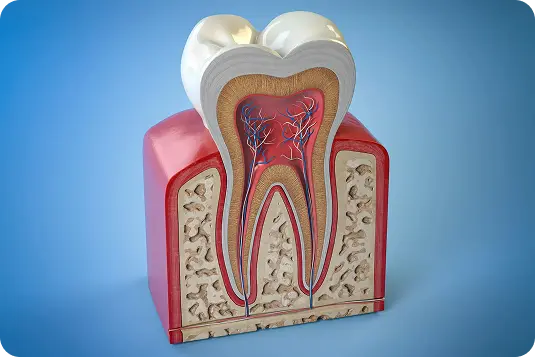
Cross-section of a tooth showing the pulp, nerves, blood vessels, and root canals, for the purpose of explaining endodontic treatment

What symptoms indicate that root canal cleaning might be necessary?

Timely consultation with a doctor is critically important. Often, patients turn to a dentist only when the pain becomes unbearable, but the body frequently sends signals much earlier. Possible symptoms indicating that a tooth canal check and potential treatment are needed include:

Pain and swelling

Persistent or throbbing pain that may radiate to the ear, jaw, or neck. Swelling of the gums in the area of the tooth. Such pain usually appears and disappears spontaneously.

Increased sensitivity

A sharp reaction to hot or cold food and drinks that persists even after the irritant is removed.

Sensitivity when chewing or touching

The tooth is sensitive when bitten on or touched with a finger or tongue.

Tooth discoloration

The tooth may turn a darker gray or yellow, indicating nerve death.

Pus or discharge

A small blister (fistula) or a small red bump may appear on the gum line, from which pus is discharged.

Sensitive lymph nodes

Enlarged lymph nodes under the jaw or in the neck area, indicating an active inflammatory process.

If you observe any of these symptoms, it is important to contact a dental specialist immediately.

The most common causes of root canal infection are the development of deep caries, tooth trauma, cracks, or fractures. To avoid such problems, prevention and gum health are essential. Learn more about oral and gum health in the materials provided by the Center for Disease Prevention and Control.

Learn more

Caring for your gums often helps prevent bacteria from entering deeper tissues.
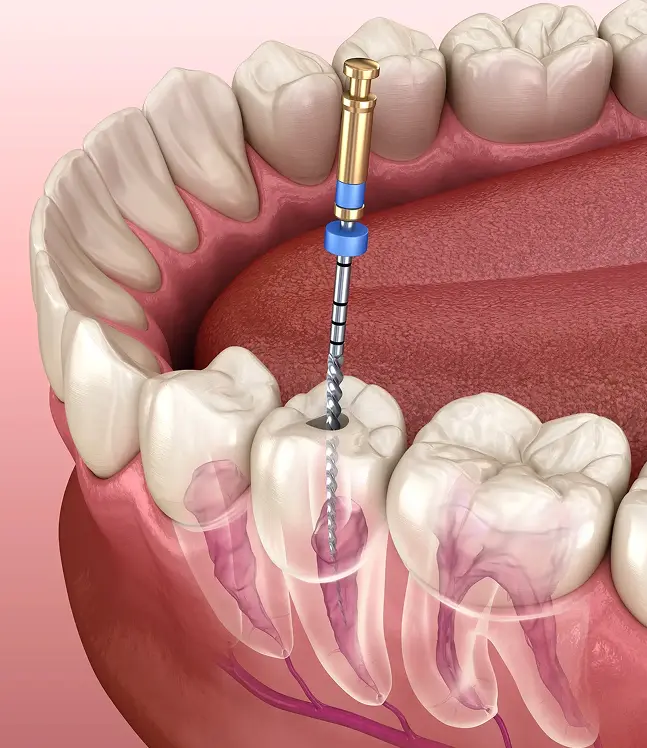
Root canal treatment, in which an endodontic file cleans the canal inside a molar

Root canal treatment: what happens during the procedure?

For many patients, the phrase “root canal treatment” causes concern, but today it can be a painless and comfortable procedure.

How does endodontic treatment happen step by step?

First, a thorough diagnosis is performed in the dental office. SmileArt Clinic has modern equipment available, including 3D X-ray (cone beam computed tomography), which allows for higher precision diagnosis to see the number of root canals, their curves, and foci of inflammation. Initially, the dentist will evaluate whether root canal treatment is necessary or if tooth extraction is required.

If the decision is made to save the tooth, the course of treatment is as follows:

ANESTHESIA
The procedure is performed under local anesthesia, ensuring that the patient feels no pain.

CREATING ACCESS
A small opening is created in the tooth (from the top for molars, from the back for front teeth) to access the tooth nerve and root canals.

CLEANING AND DISINFECTION
With special endodontic instruments (files), the infected tooth nerve tissue residue is removed. The root canal is thoroughly cleaned, widened, and disinfected. An antibacterial solution is introduced into it to destroy remaining bacteria and prevent re-infection. Canal cleaning is one of the most important stages.

Why do we perform canal treatment with a microscope?

Root canals are very tiny, so a microscope allows the doctor to work much more precisely and safely. It helps to completely clear the infection, preserve healthy tissue, and increase the chances of long-term tooth preservation.

Often, root canal treatment requires two visits. During the first visit, after thorough cleaning of the canals, medicinal drugs are placed in the tooth, which remain in the canals for approximately 10 days to completely destroy bacteria and reduce inflammation.

Only when we are certain that the symptoms have disappeared and the tooth is calm can the root canals be safely and qualitatively filled during the next visit.

FILLING
Once the canals are sterile, they are filled with a special biocompatible, rubber-like material (gutta-percha). This tightly seals the canals and helps prevent the entry of bacteria.

SEALING
The tooth is sealed with a temporary or permanent filling to ensure airtightness.

To achieve the best results and effectively eliminate both pain and inflammation, SmileArt Clinic performs root canal treatment with the help of a microscope. The microscope allows endodontic specialists to see the smallest details, additional canals, and cracks that are impossible to notice with the naked eye.

How long does the procedure take?

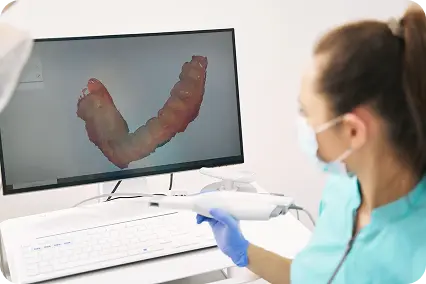
The dentist holds an intraoral scanner, and a 3D scan of the lower jaw is displayed on the computer to create a digital dental impression

The duration of the procedure depends on the complexity of the specific situation and the severity of the infection. Typically, endodontic therapy is not a single-visit event. Depending on the spread of the infection and the anatomy of the tooth, treatment may take 1 to 3 visits.

During the first visit, acute inflammation is usually addressed, canals are cleaned, and medication is applied. During the second or third visit, once the inflammation has subsided, the canals are filled and the tooth is restored. Our endodontists always inform the patient about the planned number and duration of visits after the initial examination.

Tooth restoration after treatment

The man is holding a glass of water with ice and has his hand pressed against his cheek because of a toothache caused by the cold

After endodontic treatment has been performed, the tooth no longer receives nutrients and blood supply from the inside, so it can become more brittle and lose its natural moisture. Over time, such teeth can become susceptible to fractures and cracks. Therefore, we recommend completing the treatment by placing a dental crown or an onlay (ceramic filling).

Dental crowns improve the strength of the tooth, protect it from breaking under chewing loads, and restore the aesthetic appearance of the tooth. This is an investment in a long-term result so that the preserved tooth lasts a lifetime.

Why choose SmileArt Clinic?

A dentist performs root canal treatment on a patient under a microscope in the dental office

Our clinic prides itself on experience and professionalism. Our specialists have performed thousands of successful root canal treatments, saving teeth that might be recommended for extraction elsewhere. The work of an endodontic specialist requires great precision, patience, and knowledge. Our dentists with special expertise in endodontics will ensure a maximally comfortable and professional treatment experience.

We highly value our patients’ time. All necessary dental care is available in one clinic, and there is no need to go to other facilities for X-rays or to consult with a prosthodontist after canal treatment. We have the latest technologies at our disposal, allowing us to perform complex procedures, including root canal retreatment.

A dentist wearing a mask works with a dental microscope to treat a root canal

Endodontic prices and payment options

We understand that endodontic prices and total treatment costs can sometimes deter patients from seeking necessary help. However, it should be remembered that timely root canal treatment is less expensive than losing a tooth and the subsequent implantation.

To make high-quality endodontics accessible to everyone, SmileArt Clinic offers flexible payment plans. We offer several payment plan options so that root canal treatment does not create an excessive financial burden. After a consultation where the situation is evaluated and a treatment plan is drawn up, we will create an individual payment schedule that meets your needs and budget. All expenses are explained in advance, with no surprises!

If you suspect tooth inflammation or experience the symptoms mentioned above, do not delay your visit. Endodontics is an opportunity to preserve your natural smile. Our endodontist and the rest of the team will ensure that the endodontic procedure is as pleasant as possible.

Endodontic problems do not disappear on their own. Apply for a visit at SmileArt Clinic and entrust your smile to professionals who perform endodontics daily with the highest sense of responsibility. You are investing in your health and quality of life. The result of endodontic treatment is a preserved tooth that can serve you for the rest of your life.

We look forward to seeing you at SmileArt Clinic to provide the best possible care for your teeth!